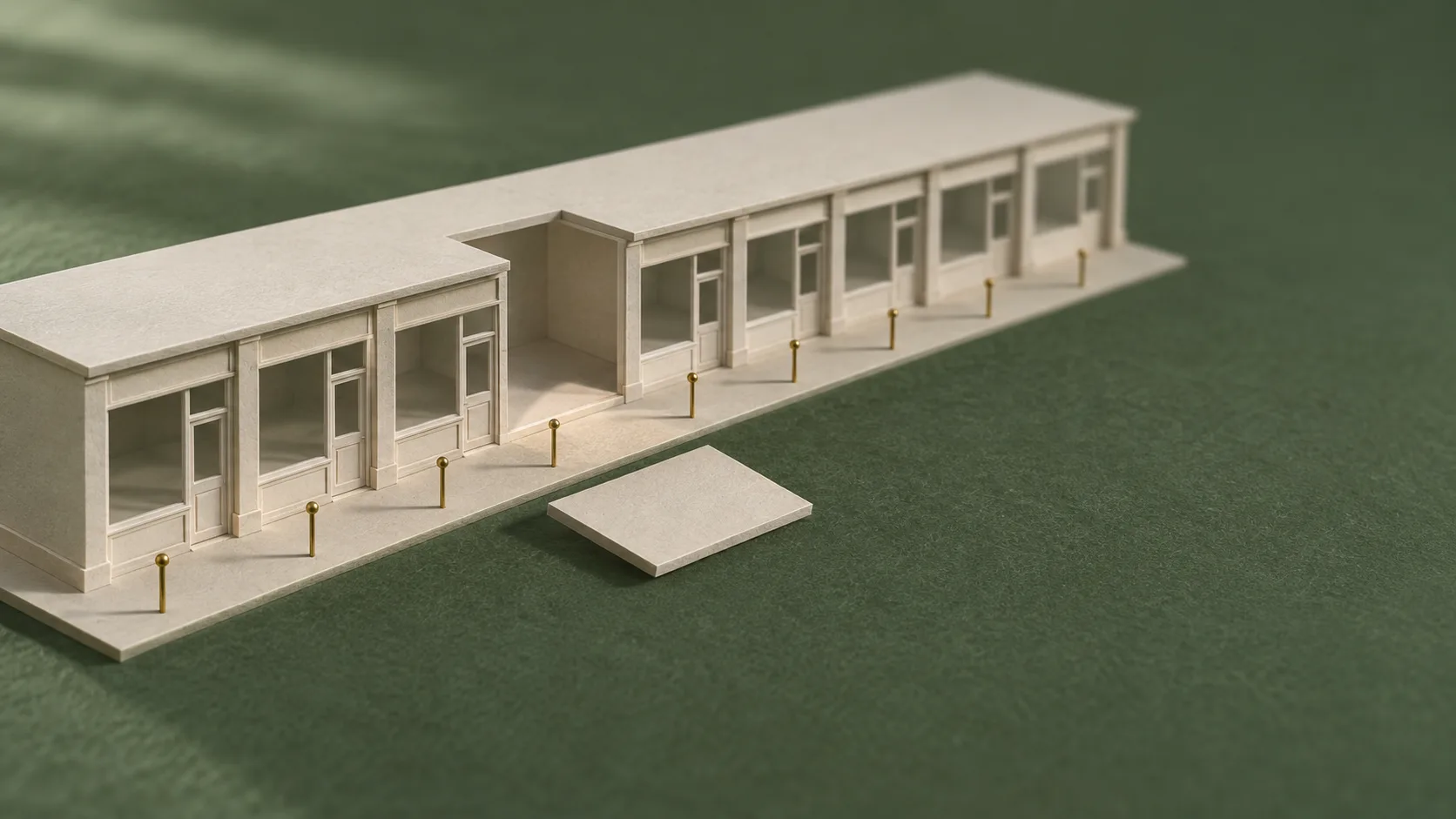
Shopping centre management software: one record for every unit
A centre earns from the leases it has signed and from the tenants who keep trading. Management software for a shopping centre, a retail park or a commercial building has to hold the facts behind that income in one place: the lease for each unit, the charges the lease creates, what the tenant sells and the work needed to keep the building running. When those facts sit in separate spreadsheets, an accounting package and the notes of the site team, every year-end reconciliation and every owner report is rebuilt by hand.
A useful test is to pick one unit and ask five questions. What rent is due this month, and why? What share of the common costs does it carry? What did the tenant report as sales? Which repair requests are open? When does the lease end? If answering takes four people and three files, that is the gap the software has to close.
What the system has to hold, and what breaks without it
| Record | It must answer | What goes wrong without it |
|---|---|---|
| Lease terms | Current rent, when it changes, break and expiry dates, options and notice periods. | Renewals are missed and charges stay at last year’s level. |
| Charges and invoices | What was billed, for which unit and which period, and from which clause. | Invoices are calculated by hand and drift from the lease. |
| Service charge account | Budget, payments on account, actual costs, allocation rule and year-end balance. | A tenant disputes a balance and no one can reproduce the calculation. |
| Tenant sales | What was reported, for which period, under which definition, and who checked it. | Sales-based rent is billed on a declaration nobody reviewed. |
| Deposits and documents | Guarantees, insurance certificates and their expiry dates. | Cover lapses unnoticed. |
| Maintenance work | The request, the unit or common area, the contractor, the cost and the closing date. | Work has no owner and its cost cannot be tied to a charge. |
Service charges: budget, payments on account and the year-end balance
The RICS professional standard on service charges, written for the United Kingdom, describes the usual pattern. The lease sets out what the landlord may recover. The landlord issues an estimate for the coming period, tenants pay a sum on account, and after the period the actual spending is compared with the budget. It also notes that shopping centres often apportion costs by a weighted floor area rather than by raw area. Your own leases govern, but the structure shows what the software must keep together.
For example, imagine a unit that carries 5% of the weighted area. Cleaning is budgeted at 100,000 for the year, so the unit pays 5,000 on account. The actual cleaning bill is 120,000, so its share is 6,000 and a balance of 1,000 is due. The same arithmetic runs for every cost heading and every unit. The software should store the budget, each payment on account, the actual cost invoices and the allocation rule, so the year-end reconciliation runs as a report.
Turnover rent and lease conditions that change the rent
Some retail leases add rent that depends on the tenant’s sales. Others change the rent if a large anchor tenant leaves; BDO’s IFRS 16 guide describes a co-tenancy clause of this kind, where the base rent is replaced by a percentage of sales. A system that stores only a monthly amount cannot apply either rule.
Record the clause as data: the reporting period, what counts as sales under the lease, any deductions, the threshold and the rate. Then keep the tenant’s declared figures next to the invoice that used them, with the name of the person who reviewed the declaration. Each charge can then be traced to the declaration it came from.
Invoices, Israel Invoices allocation numbers and lease accounting
In Israel, the Tax Authority issues an allocation number for tax invoices. Since 1 June 2026 a customer registered as an authorized dealer needs that number on an invoice above 5,000 NIS before VAT in order to deduct the input VAT (Israel Tax Authority, Israel Invoices FAQ, read 12 November 2026). A monthly rent or service-charge invoice for a retail unit can pass that amount, so the software should request the number when it issues the invoice, or hand the invoice to an accounting system that does. Check the current rule with your accountant, because the thresholds have changed in stages.
Accounting is a second reason to keep clean lease data. Under IFRS 16 a lessor classifies each lease as operating or finance, and BDO’s guide notes that operating lease income is recognized on a straight-line or other systematic basis. A rent-free period or a stepped rent therefore does not match the cash billed month by month. Ask your accountant which treatment applies to you, and make sure the software can export both the billed schedule and the recognized one.
Real estate software for developers and owners: the monthly questions
A developer or an owner of a centre asks the same questions every month. Which units are vacant, and since when? What is the current rent roll? Who is in arrears, and by how much? Which leases end in the next twelve months? What did the building earn after operating costs? These are questions about the same records the manager already keeps, so the report reads those records directly.
Leasing commercial space: tracking prospects and offers
During lease-up the software also has to follow prospects: which unit each one is negotiating for, at what stage, and what was offered. A developer who builds in phases can then see how much of the next phase is committed. You do not have to build every part at once. Leasing and billing together are a sensible first release, with service-charge reconciliation and owner reporting added once the lease data is trustworthy.
Building management: repairs, contractors and inspections
RICS guidance on commercial property management lists the daily work of a manager: liaison with tenants, operating the property day to day, buying facilities services and meeting statutory obligations. Software for building management should therefore log a request once, assign it to a contractor, record what it cost and close it with a date.
Give each job a unit or a common-area label and a cost heading. Then a repair in a shared corridor flows into the service charge account by itself, and a repair inside one unit is billed to the right tenant or to the owner. Without those two labels, maintenance and charging become separate stories.
Buy, configure or build
Products for lease administration and property management exist, and for a single building with ordinary leases one of them may be enough. Write your own lease clauses next to the product’s settings and see how many fit. Custom software starts to make sense when your charge structures are unusual, when leasing, billing and maintenance must share one record, or when tenants and staff need their own portals connected to your accounting system.
Nexo has not published a shopping-centre or leasing project. The property work on this site is OpenHouse, which covers guided property capture, 3D reconstruction and a browser walkthrough; it is a different job from managing leases. What Nexo does build is the kind of platform this article describes: records, role-based portals and connections between the systems a business already uses.
- Three of your real leases, with the clauses that change the money.
- The last service-charge reconciliation and how it was calculated.
- The systems that must connect, such as accounting and the building’s maintenance log.
- The monthly report an owner or investor asks for today.
- Who may see and edit what: managers, finance, tenants and contractors.
Sources and further reading
Tell us how your centre runs today.
Bring a few leases, your last service-charge reconciliation and the reports you build by hand. We can help define a first release around the records that matter most.
Discuss your property platform